
This is Part 2 from a post I did a few weeks ago on self-love.
The impetus for my initial post was this:
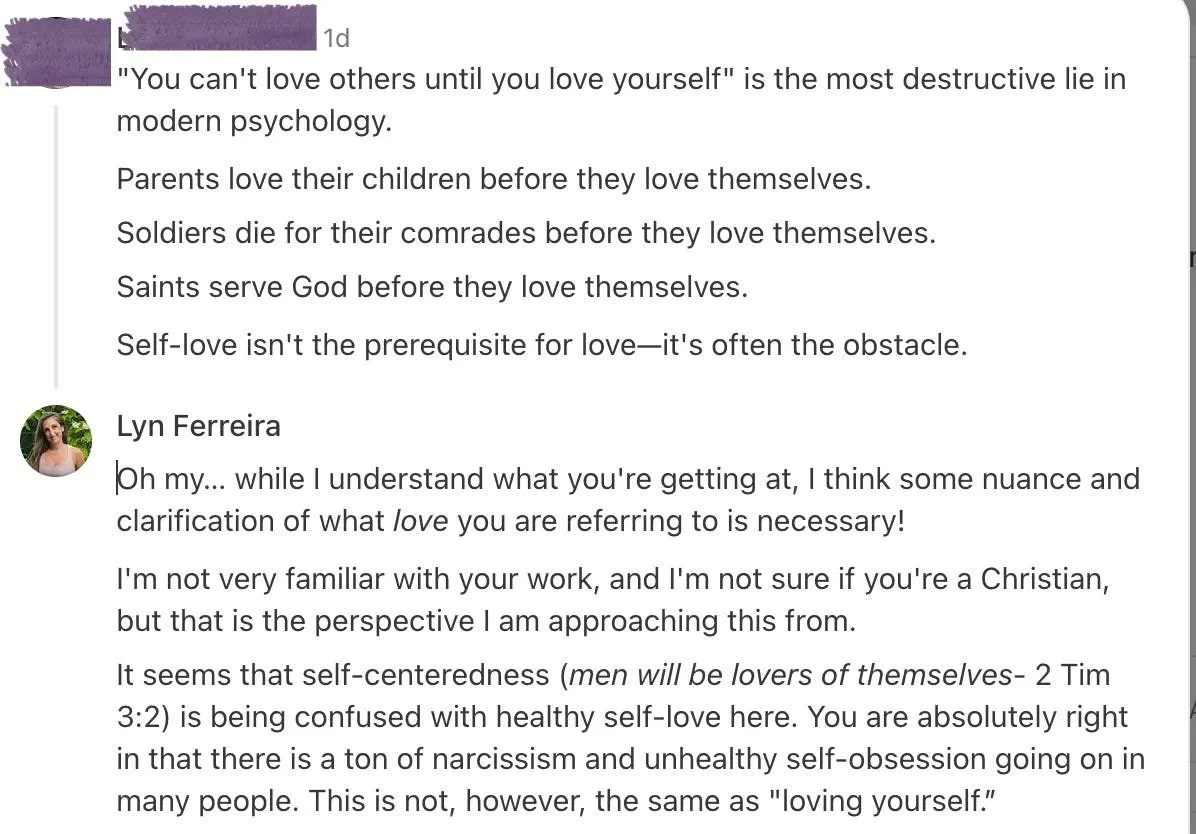
“Hot takes” like this frustrate and sadden me. They drive people deeper into self-hatred and further away from the love and grace of God. It especially pains me when believers preach anti self-love messages where they confuse self-love with selfishness.
I came across a Substack note that I had to speak up on. It hit too close to home to not say something.
I explain my thoughts on this in Part 1, so if you haven’t read it yet, go check it out!

Self-love is more than “Treat yo self.” Though, TBH sometimes getting yourself a new outfit or a massage can help!
Self-love is more than “Treat yo self.” Though, TBH sometimes getting yourself a new outfit or a massage can help!
“Teacher, which is the great commandment in the law?” Jesus said to him, “‘You shall love the Lord your God with all your heart, with all your soul, and with all your mind.’ This is the first and great commandment. And the second is like it: ‘You shall love your neighbor as yourself.’
- Matthew 22:36-39
As we discussed in Part 1, God absolutely wants us to love ourselves, and self-love is critical for loving others well. So how can we love ourselves in a healthy way?
All we need to do is take the understandings of love found in the scriptures, and apply them to ourselves!
Love is patient, love is kind. It does not envy, it does not boast, it is not proud. It does not dishonor others, it is not self-seeking, it is not easily angered, it keeps no record of wrongs. Love does not delight in evil but rejoices with the truth. It always protects, always trusts, always hopes, always perseveres.
- 1 Corinthians 13: 4-6
What does it look like to embrace this for ourselves?
1. Be Patient with Yourself
The #1 attribute of love is found in patience. Patience is tough to come by these days. We live in a society where we can get pretty much anything we want, when we want it. Amazon, Doordash, Tiktok, and so many more companies thrive by taking advantage of our impatience. We’ve lost our ability to wait.
Why is patience so critical for love? Let’s consider the opposite of patience: impatience. When we are impatient with ourselves, or others are impatient with us, the result is pressure. Jesus tells us that His burden is easy and light (Matthew 11:30). When the pressure of moving faster comes in, however, it carries heavy burdens: Why am I struggling? Why can’t I get it together? I should be healed by now. Why is this taking so long?
Patience, on the other hand, gives room—for mistakes, imperfections, process. Humanity. A patient parent gives room for their child to make mistakes. To grow in safety. An impatient parent transfers anger and frustration to their child. The same is true within ourselves. Impatience results in frustration and stress. Patience cuts us some slack. We’re doing the best we can. We’re in process. We’re not perfect and we don’t need to be.
Sustainable growth and healing take time. We will take so much stress off by giving ourselves grace to be in process. Rushing and putting pressure on ourselves to be fixed or have things figured out right now is getting in the way of our healing. Take off those time-pressured burdens and watch healing begin to open up.
Can we allow ourselves patience? To be in process? To not have everything figured out just yet? Give yourself patience and feel the relief flood in. Ironically when this pressure comes off, healing often opens up in new ways, and the journey gets expedited.
2. Treat Yourself with Kindness
The meaning of “kind” in 1 Corinthians 13 entails being mild, pleasant, and benevolent, as opposed to harsh, hard, sharp, and bitter.
Pleasant words are like a honeycomb,
Sweetness to the soul and health to the bones.-Proverbs 16:24
Kindness soothes. It brings understanding. It is not harsh or hard, biting or demanding. Even writing about it right now ministers healing to my heart. In a world surrounded by bitter vitriol, criticism, and complaining, we crave kindness. We especially long for kindness if we did not grow up with it.
Quick test of your internal kindness-compass: tune in to the thoughts you think toward yourself. Especially when you’re going through a tough time. What does the voice sound like? Is it kind and compassionate or harsh, critical, and perfectionistic?
Does your internal thought atmosphere demonstrate love for yourself? Or does it reveal contempt?
My inner voice was a near constant blast of self-criticism and self-condemnation. I never felt good enough. I was raised in an environment that prioritized achievement and performance, with a bent toward criticism. I internalized this critical voice and made it my own. For the longest time I thought I just had high standards. Turns out I was hating myself.
“But we shouldn’t think highly of ourselves,” you may counter, with a litany of references to back up your claim. This is where I’d direct you back to Part 1. You are God’s dearly loved child. You are worthy of love and of loving yourself. And that is not the same as selfishness or haughtiness.
One of the mindset applications that activates kindness is seeing the best, believing the best—in others and in yourself. Seeing the best lends a compassionate outlook. Do you see the best in yourself, or do you constantly nitpick your faults and where you feel like you don’t measure up? Again, there is no shame here. Many of our predispositions are a result of how we were treated in our early years.
What would it look like for you to speak to yourself as you would a friend? Especially when you’re going through tough times. Practice speaking kindly to yourself—out loud, if possible!
The natural outflow of shifting our internal atmosphere toward love is that our actions begin to reflect that. Even as we are in process of creating a more loving thought life, there are practical ways we can begin to love ourselves. These actions often help jump-start self-love in powerful ways!
Here are some more practical ways to love yourself.
Care for Your Temple
So husbands ought to love their own wives as their own bodies; he who loves his wife loves himself. For no one ever hated his own flesh, but nourishes and cherishes it, just as the Lord does the church.
- Ephesians 5:28-29
God designed us to thrive under certain conditions. They’re not complicated, but many of them have gotten lost in our frantic lifestyles. We’d prefer to buy the new brand of colostrum to heal our health woes rather than eating vegetables, going for a walk, and sleeping properly. We don’t have time for the normal boring health stuff. We want the next hack. Precision Nutrition, where I did my coaching certification, calls this “mowing the lawn when the house is on fire.” You could also call it “majoring in the minors.”
When we get back to the basics of caring for ourselves, we do well. Many of the struggles we attribute to the enemy or some spiritual resistance are simply a result of not caring for ourselves. This is the natural consequence of neglecting God’s design.
We can honor our beautiful temple by prioritizing the following.
Eat Well
Fuel your body like it is a gift. Eat whole foods. Minimize processed foods, sugars, and refined carbs. Emphasize vegetables, protein, complex carbs, and healthy fats. If you’re too busy to cook, sign up for a good meal delivery service. If you’re a woman, make sure you eat a protein-rich breakfast.
Eating junk, skipping meals, surviving on coffee and diet coke may feel very cool and corporate (and impressive to the big boss), but it’s not impressive to God who created you. It is unloving. You will be amazed at how much better you feel when you clean up your eating!
Rest
Your body needs rest. Sleep, yes: 7-9 hours. But also regular pauses of rest throughout your everyday life. Daily moments of quiet and stillness to breathe. Maybe a nap here or there. A weekly Sabbath (don’t be legalistic about it. If you need to do two half days, do it. But some sort of weekly pause is important.) And lengthier pauses throughout the year.
One of the beauties of being a believer is that God has called us to a lifestyle of rest, where we’re able to walk through this troublesome world with lightness (Matthew 11:30). Instead of crash-landing in our times of pause, we can adopt a more restful posture in our day-to-day life. One of the best ways to do begin practicing this is to simply slow down.
There remains therefore a rest for the people of God. For he who has entered His rest has himself also ceased from his works as God did from His.
- Hebrews 4:9-10
Move
Our bodies work better when we move regularly. Our brains are sharper, our digestion functions better, our metabolism is improved, blood sugar is more balanced, risk of chronic diseases decreases, and we sleep better. We are designed for movement. Don’t complicate it. Start by walking 30 minutes/day. Do what you enjoy—garden, go for a hike, throw a frisbee—anything that gets you moving!
Cultivate Enjoyment
Command those who are rich in this present age not to be haughty, nor to trust in uncertain riches but in the living God, who gives us richly all things to enjoy.
- 1 Timothy 6:17
Doing what you enjoy is loving! You were created, not simply to work and serve more, but also to enjoy being God’s child, to enjoy the gifts and unique interests He has given you.
What brings you joy? Sitting with a cup of coffee and a book? Watching the birds? Going for a long bike ride? Playing a game with friends? Explore what brings you joy and make regular time for those things.
Connect
Engaging in loving relationships is a crucial aspect of being human, loving ourselves, and loving others.
Dear friends, let us love one another, for love comes from God. Everyone who loves has been born of God and knows God. Whoever does not love does not know God, because God is love.
-1 John 4:7-8
For the lone wolf, independent types, I see you. I get it. It can be rough out there, and relationships require effort. Certain upbringings also produce the fiercely independent type (raises hand sheepishly).
That being said, connecting with safe people is one of the most loving things we can do. Trustworthy friendships provide an atmosphere of mutual support, encouragement, feedback, and safety. They can call out the best in us and speak to who we are when we’re getting tripped up in unfruitful thinking patterns. Good friends can also help us recognize when we’re going off track. Just having someone to listen compassionately and not judge is incredibly healing. You only need one or two friends like this.
Jesus was the example of God’s Love, walking here on planet Earth. He cared for himself—ate meals, moved, rested, connected with people, he took time away (lots of time in fact!) from the crowds to pray and be with the Father. From this centering in love, He loved others.
Of course there are times in life where our self-love practices may take a hit, for example the arrival of a new baby. God meets us with His grace in those times. But this should not be the general MO for our life. Too many of us get our feelings of significance from doing more and working harder, with busyness and self-neglect as a strange badge of honor (thank you hustle culture). If we are going to experience healing within ourselves, our families, and our communities, we’ve got to embrace loving ourselves.
So love yourself well, my friends! Only from that place can we love others well. And Lord knows our world could use some true love right now.
Which aspect of self-love stood out to you? Comment and let me know!